
PROFESSIONAL IDENTITY
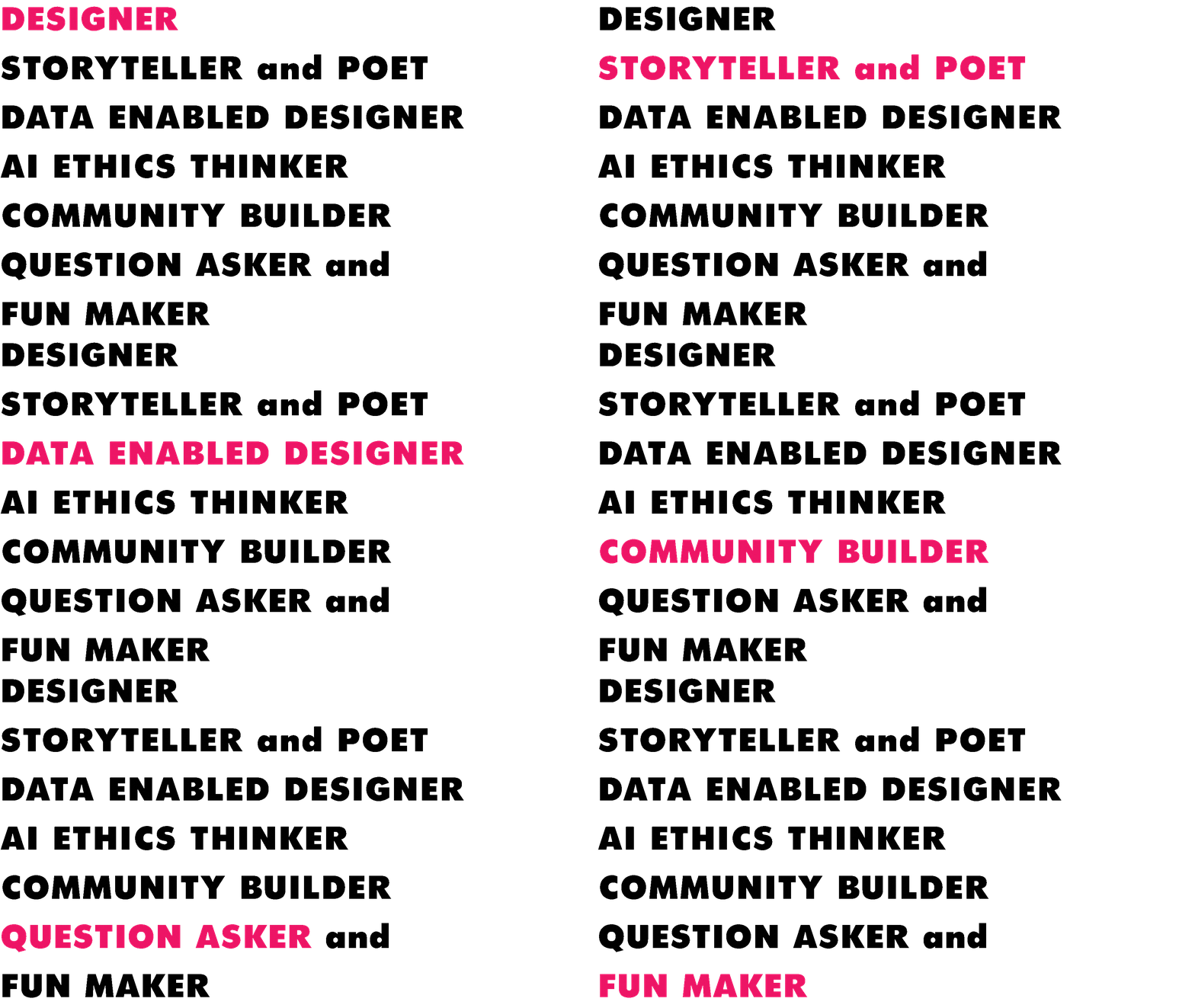
My father once told me; “Everything is interesting if you’re interested.” I took this message to heart. My identity as a designer is rooted in a deep curiosity about people and the world around them. I am interested in people at different levels of abstraction: Their inner processes of reflection, emotion and meaning making, their relationships with others and their position within larger social and technological systems. For this reason, User & Society is one of my stronger expertise areas, not only was I able to develop plenty of practical skills in it during my bachelor and extra curriculars, but it is also a big part of my vision.
My upbringing also cultivated a love for culture and art. This still shapes the way I approach designing and creativity. Additionally, I am a Spoken Word artist and have been performing with my poetry on various stages for a little over 10 years. This is why storytelling is an important tool for me. I like to design experiences and concepts that humanize abstract topics and invite emotional as well as intellectual engagement. I often use storytelling, play, provocation and performative elements to make the complexity feel approachable and to encourage reflection. This is not only visible in my concepts, but also in my use of aesthetics; I like to design things that look fun and evoke curiosity and I often choose metaphors or intuitive interactions to keep my designs engaging.
In design processes, I naturally take on the role of researcher, sense-maker and connector. I enjoy immersing myself in the context, identifying patterns across social, technological, and cultural layers, and translating abstract insights into tangible experiences I work well in exploratory, research-driven processes where ambiguity is allowed and where design functions as a tool for inquiry and I often take a leading role, but my approach in this is to connect perspectives and create spaces where people feel safe to share stories, reflect, and engage in dialogue.
Because I am good at analytical and critical thinking, I am comfortable working with data, and AI while also being critical of how these tools are developed and applied. Therefor my expertise in Math, Data & Computing is both practical, due to my minor in AI and my experience with data analytics, and reflective due to my focus on ethical reflections and me being able to develop this during courses and the USE learning line during my bachelor.
I am also quite ambitious and entrepreneurial by nature. Since childhood I’ve always been organizing, experimenting and building things. I am goal oriented and manage to combine this with a slightly opportunistic and solution-oriented mindset. This has resulted in a lot of practical skills related to Business & Entrepreneurship. Sometimes I do have a “Sky is the Limit’ mentality which can push me towards overly ambitious goals. To slow myself down I’ve implemented different methods: I write, draw and work with my hands a lot. This grounds me and has become an important part of my process. Therefore, I also have decent making skills that fit with Technology & Realization. Similarly, because I value a deep understanding of my context, I can sometimes delay decision making, luckily, I have found that my project management skills provide a good balance to this tendency and I am able to be strict with myself, when I need to move on.
Looking forward, I would like to be a design (researcher) who creates moments of connection and meaning making in a complex world. I want to continue developing my ability to critically engage with technology
VISION ON DESIGN
I believe the role of the designer is changing as we live in a world that is increasingly shaped by abstract, economy-driven systems such as data infrastructures, AI, and institutional logics. Although I think these systems have the potential to help address complex societal issues, I increasingly see how they can also contribute to disconnection, polarization, and a loss of meaning in everyday life. While there is already a lot of critique on this in academia, I see a big gap between these ideals and the realities of how systems are being implemented.
I believe that design can respond to this tension by translating complexity into tangible, embodied, and experienceable forms that people can feel, reflect on, and discuss together. I see design as a social and cultural practice that can create room for connection, dialogue, and meaning making. Given the speed and scale at which technological systems are shaping society, I believe it has become more urgent to challenge dominant trajectories and open up alternative directions through design.
My vision is grounded in the belief that people need connection, meaning, and room for personal growth in order to live fulfilling lives. Care, justice, and relationality are important values for me. I am inspired by feminist perspectives on knowledge and ethics that emphasize interdependence, vulnerability, and attentiveness to whose voices are heard. Values such as transparency, shared decision-making, and listening to multiple voices become more important, especially as individuals are losing agency and power and more decisions are being made on their behalf. For me, feminist perspectives offer a way to stay attentive to how power operates in systems, and to keep space open for care, responsibility, and participation.
With these perspectives, I see data as a design material that can be used to support a more inclusive and fair future. My interest in data comes from the fact that I think knowledge plays an important role in making informed and responsible decisions. Data can help us learn about ourselves and others, and has the potential to support choices that benefit collective well-being. At the same time, when data is incomplete, biased, or unrepresentative, it risks reinforcing existing inequalities. This is why I believe it is important to critically engage with how data is collected, interpreted, and used in design processes. When working within a complex society, I believe discussion, learning, and iteration are essential, and I see designers as people who help shape how these conversations take shape.
In this, I see myself as a connector between technology and humans. I want to design situations that help people reconnect with themselves, with others, and with the systems that are shaping their lives, while also working towards a more inclusive and community-based future.